AdZio Logo
Get a Quote
+91-9233973156
marketing.adzio@gmail.com
Official Knowledge Base

Frequently Asked Questions About Digital Marketing

Explore authoritative, transparent answers to over 140+ commercial and technical questions. Understand how Search Engine Optimization, Google Ads, website architecture, social campaigns, and custom pricing models function for your business.

140+ Questions Answered
28 Categories Covered
100% Fact-Checked Guidance
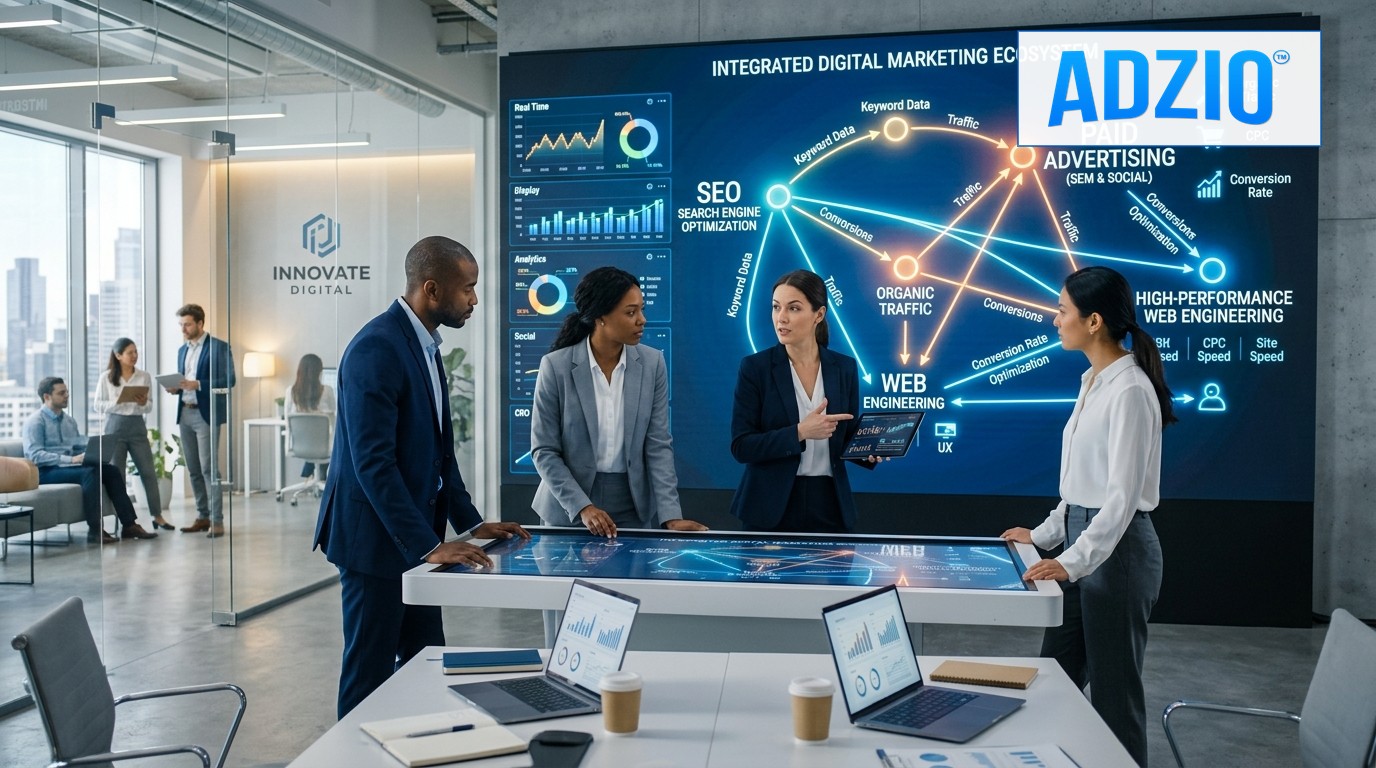
AdZio Digital Marketing Knowledge Base and FAQ Consultation
Found 0 matching questions Reset search

General Digital Marketing

5 Questions

Digital marketing encompasses all promotional efforts conducted through the internet and electronic devices. Unlike traditional print or billboard advertising, digital marketing enables businesses to target specific demographics, track consumer interactions in real time, and measure the exact cost of acquiring every customer. By leveraging search engines, social media, email, and websites, businesses can build continuous brand visibility and predictable sales pipelines.

Traditional advertising (newspapers, flyers, television, radio) broadcasts a message to a broad, unsegmented audience with limited tracking capabilities. Digital marketing allows laser-targeted delivery to individuals actively searching for specific products or exhibiting distinct purchasing intent. Furthermore, digital marketing provides comprehensive attribution metrics, allowing businesses to adjust budgets and creative messaging dynamically based on measurable performance.

Timelines vary by marketing channel. Paid advertising on platforms like Google Ads and Meta Ads can generate immediate traffic and phone inquiries within 24 to 48 hours of campaign launch. In contrast, organic channels such as Search Engine Optimization (SEO), authority content marketing, and brand building generally require 3 to 6 months to establish strong momentum, compound rankings, and deliver sustainable organic growth.

Outbound marketing pushes promotional messages outward to prospects whether they requested them or not (such as cold calls, radio spots, or interruptive banner ads). Inbound marketing focuses on attracting high-intent prospects by providing valuable solutions, ranking for their search queries on Google, and answering their questions. Inbound leads typically have higher conversion rates because the consumer initiates contact.

Yes, through local search engine optimization, hyper-targeted geo-fenced advertising, and niche community positioning. When a customer in Udaipur or Agartala searches for "best diagnostic clinic near me" or "furniture showroom Udaipur", Google prioritizes local relevance and proximity over national domain authority. A well-optimized local business profile and fast website allow small enterprises to outrank national corporations within their geographical footprint.

AdZio Services

5 Questions

AdZio provides a full-spectrum digital marketing suite including Search Engine Optimization (SEO), Local Google Maps ranking, Google Ads PPC management, Social Media Marketing on Meta and LinkedIn, Custom Website Design and Development, Brand Identity and Logo Creation, Conversion Rate Optimization (CRO), and Performance Lead Generation. Explore our full ecosystem on our Our Services page.

AdZio operates with an engineering-first, consultative mindset. Rather than offering superficial vanity metrics (such as impressions or unsegmented page likes), we engineer integrated marketing systems tied directly to commercial revenue, customer inquiries, and measurable ROI. We provide 100% transparent reporting, separated ad spend accounts, and dedicated strategists. Learn more on Why Choose AdZio.

Yes. We frequently partner with traditional retail stores, clinics, dealerships, and manufacturing enterprises transitioning to modern digital operations. We audit their existing market presence, build high-speed corporate websites, configure local Google presence, establish social branding, and execute paid customer acquisition campaigns tailored to their sector.

Absolutely. Effective marketing requires both emotional resonance and mathematical precision. Our team pairs creative graphic designers and copywriters who craft compelling visual narratives with technical analysts who optimize site architectures, manage conversion tracking scripts, and refine bidding algorithms.

Getting started is straightforward. You can initiate a dialogue by submitting our Request a Callback form for an introductory phone consultation or submitting your detailed requirements via our Request a Quote page to receive a comprehensive proposal.
AdZio Search Engine Optimization and Organic Strategy Consultation
PRACTICE SPOTLIGHT

Search Engine Strategy & Organic Dominance

Sustainable first-page rankings require technical precision, content authority, and continuous link optimization without short-cut tactics.

Search Engine Optimization (SEO)

5 Questions

SEO is the systematic discipline of enhancing a website's technical infrastructure, content relevance, and domain authority to achieve higher organic (non-paid) visibility on search engines like Google. It is essential because over 70% of clicks go to organic search results. A top organic ranking establishes immense brand credibility and generates a continuous stream of qualified customer inquiries without paying for every single click.

On-page SEO refers to optimizations performed directly on your website—such as keyword intent mapping, heading structures (H1, H2), metadata optimization, image alt tags, internal linking, and content quality. Off-page SEO refers to external authority signals that occur outside your website, primarily acquiring high-quality backlinks from reputable websites, brand mentions, and local directory citations.

For low-competition local search queries in specific regions, meaningful first-page movement can often be observed within 60 to 90 days. For competitive commercial keywords or national markets, achieving sustainable first-page rankings typically requires 4 to 8 months of consistent on-page technical refinement, high-value content publishing, and authority backlink acquisition.

No reputable agency can ever guarantee a #1 ranking on Google. Google's proprietary ranking algorithms consider hundreds of dynamic variables, user search history, and competitor optimizations that evolve constantly. At AdZio, we strictly follow white-hat Google Webmaster Guidelines and focus on measurable organic traffic growth and lead quality rather than making deceptive ranking guarantees.

Fluctuations are normal in organic search. Google frequently updates its search algorithms (such as core updates, spam updates, and helpful content updates). Furthermore, competitors continuously publish new content and earn backlinks. User search intent and seasonal browsing behaviors also shift. A sound SEO strategy focuses on long-term upward trajectories rather than daily variance.

Local SEO

5 Questions

Local SEO focuses on optimizing your digital presence to attract customers from a specific geographic area. It powers the Google Local 3-Pack and Google Maps results when users search with geographic modifiers (e.g., "doctor in Agartala", "real estate dealer Udaipur") or local intent ("near me"). Any business with a physical location or regional service area—including clinics, showrooms, restaurants, and contractors—benefits immensely from Local SEO.

Optimizing your Google Business Profile (formerly GMB) requires complete and accurate business details, selecting the correct primary and secondary business categories, adding high-resolution interior and exterior photos, keeping operational hours updated, regularly posting updates or offers, and proactively earning authentic customer reviews with relevant service keywords.

NAP stands for Name, Address, and Phone number. Google verifies the legitimacy and trustworthiness of a local business by cross-referencing its NAP data across authoritative directories (Justdial, Sulekha, IndiaMART, Facebook, Yelp). Inconsistent phone numbers or conflicting street addresses create algorithmic confusion and undermine local ranking authority.

Customer reviews are one of the most powerful ranking signals for Google Maps. Google evaluates review volume, average star rating, review velocity (consistent inflow), and the specific keywords customers use in their reviews. Additionally, business owners who actively respond professionally to all positive and negative reviews signal active engagement, boosting algorithmic trust.

Yes, by setting up properly configured Service Area Business (SAB) designations on Google Business Profile and building dedicated geographic landing pages on your website tailored to specific neighboring towns (e.g., "Digital Marketing Services in Agartala" and "Digital Marketing in Udaipur"). These pages should feature localized case studies, testimonials, and relevant regional content.

Technical SEO

5 Questions

Technical SEO refers to server and website optimizations that enable search engine spiders to crawl, interpret, and index your pages effortlessly. If a website has crawl errors, broken redirects, slow server response times, or duplicate content, Google cannot evaluate its content properly, regardless of how well-written the articles may be.

Core Web Vitals are a standardized set of user experience metrics established by Google. They measure Largest Contentful Paint (LCP - loading performance), Interaction to Next Paint (INP - responsiveness), and Cumulative Layout Shift (CLS - visual stability). Websites that pass Core Web Vitals provide superior user experiences and earn a recognized ranking advantage in Google's search algorithms.

Schema markup is machine-readable code added to a webpage using JSON-LD format that explicitly defines the content to search engines (e.g., identifying that a page represents a LocalBusiness, MedicalBusiness, FAQPage, Article, or Product). Schema allows Google to generate rich search snippets, star ratings, breadcrumb paths, and direct answers in search engine results pages.

Google exclusively uses the mobile version of a website for indexing and ranking (mobile-first indexing). If your desktop site has rich content but your mobile layout is stripped down, difficult to navigate, or slow, your search rankings will suffer across both mobile and desktop searches. Every website created by AdZio is engineered mobile-first.

A robots.txt file tells search engine crawlers which sections or URLs of your website they are allowed or forbidden to crawl (such as admin login panels). An XML sitemap is a structured roadmap that lists all important canonical URLs you want search engines to discover, crawl, and index efficiently.

Google Ads & PPC

5 Questions

Google Ads operates on an auction-based Pay-Per-Click (PPC) model. Businesses bid on specific search queries related to their services. When a prospective customer searches for those keywords, Google displays sponsored ads above organic listings. The advertiser only pays when a user actively clicks on their ad to visit their website or call their business.

Google Search Ads appear directly on Google search results pages when users actively search for relevant keywords (capturing high-intent demand). Google Display Ads are visual banner graphics that appear across millions of third-party websites, blogs, news portals, and YouTube to build brand awareness, introduce new offerings, and retarget past website visitors.

Negative keywords are specific search terms you instruct Google not to trigger your ads for. For example, a luxury real estate developer can add "free", "cheap", "jobs", and "download" as negative keywords. This prevents wasted ad spend on irrelevant search traffic, drastically improving click-through rate (CTR) and conversion ROI.

Quality Score is a diagnostic rating (from 1 to 10) assigned by Google measuring the relevance of your keywords, ad copy, expected click-through rate, and landing page experience. High Quality Scores allow advertisers to secure top ad positions at significantly lower costs-per-click (CPC) than competitors with low-quality ad experiences.

Performance Max is an automated, goal-based campaign type that utilizes Google's machine learning to optimize bids and asset combinations across all Google channels—including Search, Display, YouTube, Gmail, Maps, and Discover—from a single campaign framework to maximize conversion volume within target budget parameters.
AdZio Social Media Marketing and Creative Visual Strategy
PRACTICE SPOTLIGHT

Social Media Engagement & Lead Funnels

Building authentic audience communities across Meta and LinkedIn while delivering laser-targeted customer acquisition campaigns.

Social Media Marketing

5 Questions

Organic social media involves publishing unpaid posts, images, and reels to your existing followers to build brand identity and community. Due to algorithm constraints, organic posts typically reach less than 5% of your followers. Paid social advertising uses Meta Ads Manager or LinkedIn Ads to target users based on location, demographics, job titles, and browsing interests, generating predictable customer inquiries.

Platform selection depends entirely on your target audience. Visual consumer industries (jewellery, automobile, fashion, dining, hospitality) excel on Instagram and Facebook. B2B service firms, software agencies, and commercial contractors achieve superior lead quality on LinkedIn. Local service providers find strong inquiry volume through targeted Meta campaigns and WhatsApp integrations.

Meta Ads Manager provides advanced targeting options including geographical radii (e.g., 10 km around an Agartala clinic), age brackets, gender, industry interests, and behavioral characteristics. It also enables Custom Audiences (uploading customer lists or past site visitors) and Lookalike Audiences to find users who share identical characteristics with your best existing customers.

Short-form video content commands the highest algorithmic reach across Instagram, Facebook, and YouTube Shorts. Video allows businesses to demonstrate product features, share authentic customer testimonials, showcase behind-the-scenes expertise, and humanize their brand in under 30 seconds, driving significantly higher engagement than static image graphics.

Consistency and content quality matter more than sheer volume. For most business enterprises, publishing 3 to 4 well-produced, value-driven posts or reels per week combined with daily Instagram stories maintains high audience recall without exhausting creative resources or spamming follower feeds.

Content Marketing

5 Questions

Content marketing is the strategic creation and distribution of valuable, relevant, and consistent informational assets—such as in-depth articles, case studies, videos, and guides—to attract and retain a clearly defined target audience. By answering common buyer questions before the sales pitch, businesses build authority and earn the customer's trust when they are ready to purchase.

Search engines favor websites that demonstrate topical authority. Publishing detailed articles addressing specific customer problems allows a website to rank for dozens of long-tail search phrases. Furthermore, high-quality informational content attracts organic backlinks, improves internal linking pathways, and keeps visitors engaged on your site longer.

Search intent describes the underlying reason a person conducts an online query. Intent falls into four primary categories: Informational ("how does dental implant work"), Navigational ("AdZio contact page"), Commercial Investigation ("best SEO agencies in India"), and Transactional ("request digital marketing quote"). Effective content maps directly to the specific intent stage of the prospect.

Write first for human clarity, then optimize technically for search engine algorithms. Use natural conversational language, clear headings, bullet points, and authoritative facts. Ensure the core search keyword appears naturally in the title and opening section without awkward repetition or forced phrasing, strictly adhering to Google's Helpful Content standards.

Lead magnets (such as checklists, industry benchmark reports, or cost calculators) provide high-value resources in exchange for a prospect's name, email, and phone number. This converts anonymous website visitors into identifiable sales leads who can then be nurtured through targeted email sequences or personal consultations.

Website Development

5 Questions

Generic site builder templates often carry thousands of lines of bloated code, unnecessary plugins, and sluggish scripts that severely harm mobile page speed and SEO crawlability. A custom-built, modular website is lightweight, loads in under two seconds, provides customized user conversion funnels, and maintains strict security without plugin vulnerability risks.

A brochure website simply presents static company information like a printed flyer. A lead-generation website is engineered as an interactive commercial conversion asset. It features clear call-to-action buttons, high-speed mobile forms, click-to-call integrations, customer proof, and dedicated landing pages tailored to convert traffic into qualified inquiries.

Data consistently shows that every one-second delay in page load time reduces customer conversions by approximately 7%. Mobile users expect instantaneous browsing. If your website takes more than 3 seconds to load, over 40% of potential customers will bounce back to Google and click on a competitor's link.

Yes, custom modular PHP provides exceptional speed, server-level flexibility, rock-solid security, and complete architectural control without the maintenance overhead, database bloat, and plugin update conflicts common in heavy CMS frameworks.

Every professional website must feature an active SSL certificate (HTTPS encryption), cross-site request forgery (CSRF) token protection on forms, honeypot anti-spam filters, input sanitization to prevent SQL injection and cross-site scripting (XSS), and secure HTTP security headers.

E-Commerce Marketing

5 Questions

E-commerce marketing drives sales through high-intent search acquisition (Google Shopping ads, e-commerce product SEO), social discovery and retargeting (Meta dynamic catalog ads), abandoned cart recovery sequences, and email/WhatsApp retention marketing designed to maximize Customer Lifetime Value (LTV).

Google Shopping ads display actual product imagery, prices, review ratings, and store names at the top of Google search results when users search for commercial goods. They link to a synchronized Google Merchant Center product feed, allowing users to compare visual products before clicking through to your store.

Shopping cart abandonment is mitigated using automated multi-channel triggers: dynamic retargeting ads displaying the exact products left behind, automated WhatsApp reminders with quick checkout links, and exit-intent prompts offering limited-time incentives to complete the purchase.

AOV represents the average rupee amount spent each time a customer places an order. It can be increased by implementing strategic product bundling, free-shipping minimum thresholds (e.g., "Free shipping on orders above ₹1,499"), related product upsells on the cart page, and post-purchase checkout cross-sells.

Product schema markup (JSON-LD) informs Google of critical product details including price, currency, availability (in stock / out of stock), SKU, and customer review star ratings. This enables Google to showcase rich product snippets directly in organic search results, substantially increasing click-through rates.

Lead Generation

5 Questions

A vanity click is simply a visitor landing on your website and exiting without action. A qualified lead is an active prospect who meets your target profile (location, budget, requirement) and has willingly provided their contact information, phone number, and commercial project details requesting a consultation, callback, or quote.

A homepage has multiple navigation menus, links, and broad company overviews intended for exploration. A dedicated landing page is stripped of navigation distractions and designed around a single focused objective (requesting a quote or booking an appointment), typically producing conversion rates 2x to 4x higher than standard homepages.

Customer Acquisition Cost (CAC) is calculated by dividing total sales and marketing expenses (ad spend + agency fees + creative costs) over a given period by the number of new paying customers acquired during that timeframe. Maintaining a healthy CAC-to-LTV ratio is the foundation of profitable business scaling.

In fast-paced markets like India, mobile consumers prefer instant communication over filling out lengthy forms. Click-to-call and WhatsApp click-to-chat campaigns connect prospective buyers directly to your sales desk within seconds, drastically reducing response friction and increasing booking rates.

Not every lead is ready to transact on day one. Unconverted leads should be placed into an automated lead nurturing workflow involving educational email digests, WhatsApp updates, and subtle social media retargeting showcasing recent client success stories until they reach buying readiness.
AdZio Website Development and Conversion Rate Architecture
PRACTICE SPOTLIGHT

High-Speed Web Architecture & User Conversion

A website must load under two seconds and guide mobile visitors effortlessly into submitting qualified inquiries.

Conversion Optimization (CRO)

5 Questions

CRO is the systematic process of increasing the percentage of website visitors who complete a desired action—such as submitting an inquiry form, calling your desk, or purchasing a product. Doubling your conversion rate from 2% to 4% effectively doubles your leads and revenue without spending an additional rupee on advertising traffic.

Common conversion roadblocks include slow loading speeds, overly long forms demanding unnecessary personal information, lack of prominent phone numbers on mobile headers, missing customer testimonials, and confusing navigation menus that bury service information.

A/B testing involves directing incoming traffic equally between two variations of a marketing asset (such as testing two different headlines, form layouts, or call-to-action button colors). By analyzing which variation generates a statistically superior conversion rate, businesses make data-backed design decisions.

Over 80% of local service searches in India originate on mobile devices. If form fields are difficult to tap, text is too small to read without zooming, or buttons shift unpredictably during page load, mobile users will immediately leave your site in frustration.

Social proof is the ultimate conversion catalyst. Prospective clients seek validation that your business has solved similar problems for others. Featuring authentic client testimonials, before-and-after metrics, and verified reviews near conversion forms significantly reduces perceived risk and increases inquiry submissions.

Branding & Design

5 Questions

First impressions matter immensely in digital commerce. A professionally designed logo, cohesive typography, and polished visual collateral establish instant corporate credibility. Businesses with strong brand identity command higher pricing power, earn customer loyalty, and stand apart from commoditized competitors.

A comprehensive brand identity package includes primary and secondary logo variations, responsive icon marks, official brand color palettes (with exact HEX and RGB codes), typography hierarchies, stationery templates (business cards, letterheads), social media brand kits, and comprehensive brand guidelines.

A logo is simply a graphic symbol or mark used to identify an entity. A brand design system is a comprehensive visual and verbal language—governing how imagery, color tones, copywriting style, typography, and spacing interact across your website, advertisements, packaging, and office signage.

When a user sees a Facebook ad, clicks through to a landing page, and subsequently visits an office, visual consistency reassures them that they are dealing with a legitimate, high-standard organization. Disjointed graphics and amateur design cause subconscious distrust, resulting in high bounce rates and wasted ad spend.

Yes. We frequently conduct brand evolutions and logo modernizations. We refine outdated graphic elements, improve digital legibility for small mobile screens, and update color palettes while retaining the core recognizable visual motifs that your established customers know and trust.

WhatsApp Marketing

5 Questions

WhatsApp is the most widely adopted communication channel in India, boasting over 95% open rates. Businesses can utilize WhatsApp to provide instant inquiry responses, send automated booking confirmations, provide customer support, deliver order tracking updates, and re-engage prospects with permission-based offers.

The free WhatsApp Business App is designed for single-device small operations with manual messaging limits. The WhatsApp Business API is engineered for scaling enterprises, enabling multi-agent customer support dashboards, CRM integrations, verified Green Tick badges, automated chatbot workflows, and broadcast notifications.

Speed-to-lead is critical; responding within 5 minutes increases conversion likelihood by over 80%. When a prospect submits a website form, an instant automated WhatsApp message confirming receipt and offering immediate answers eliminates the communication lag common in traditional email workflows.

Click-to-WhatsApp ads feature a direct messaging button. When a mobile user taps the ad, it immediately opens a pre-populated chat window in WhatsApp on their phone, allowing them to initiate a conversation with your sales team in a single tap without filling out cumbersome web forms.

Meta strictly enforces anti-spam policies on WhatsApp. Businesses must obtain explicit consent (opt-in) from users before sending promotional messages. Sending unsolicited bulk messages to scraped phone numbers will result in immediate account flagging and permanent phone number bans.

Healthcare Marketing

5 Questions

Patients search with high intent when experiencing specific health symptoms or seeking specialists nearby (e.g., "pediatrician in Agartala", "best orthopedic clinic near me", "emergency ultrasound Udaipur"). They evaluate proximity, doctor qualifications, Google Maps reviews, operational timings, and clinic cleanliness before calling.

Google and Meta maintain strict healthcare policies prohibiting unverified medical claims, exaggerated cure promises, sensational before-and-after imagery, and retargeting ads based on sensitive medical conditions. Healthcare marketing must focus on verified doctor credentials, educational information, and patient amenities.

By maintaining verified department profiles, linking individual doctor bios, publishing detailed diagnostic service descriptions, and maintaining strong Google Maps rankings, clinics ensure they are visible the moment local families seek medical care.

Medical decisions involve anxiety and trust. When a doctor publishes short, empathetic video reels explaining symptoms, prevention tips, and modern treatment options, patients develop familiarity and confidence, making the clinic their natural choice for consultation.

Hospitals and clinics must never disclose protected patient medical details in public review responses. Negative feedback should be acknowledged with empathy, followed by an immediate invitation to resolve the concern offline with clinic administration.

Automobile Marketing

5 Questions

Vehicle buyers conduct extensive online research prior to visiting a physical showroom. They compare on-road prices, EMI financing options, safety ratings, color variants, and showroom customer reviews across Google, YouTube, and social media.

By bidding on specific transactional keywords such as "[Brand] on-road price Agartala" or "[Model] showroom near me", dealerships capture buyers in the final decision phase, directing them to quick test-drive booking forms or direct WhatsApp sales lines.

Authorized workshops benefit from local Google Maps dominance for search queries like "car periodic service Udaipur" and automated service reminder campaigns via WhatsApp, combined with seasonal maintenance packages (such as monsoon or summer checkup drives).

Meta and Google Ads permit advertisers to set a tight 5 km to 15 km geographic radius around their physical showroom. This ensures ad spend is concentrated strictly on local residents who can feasibly visit the dealership for test drives and vehicle delivery.

High-definition video walk-throughs showcasing vehicle interiors, dashboard infotainment features, and boot capacity help potential buyers visualize ownership, significantly increasing test-drive booking requests.

Real Estate Marketing

5 Questions

Real estate lead generation requires high-intent Google Search advertising for localized commercial keywords, Meta visual ads showcasing floor plans and architectural renders, and dedicated project landing pages that require property buyers to specify their budget and unit preference (2BHK, 3BHK, Commercial Plot).

Real estate advertising often generates casual or unqualified clicks if forms are too simple. Adding qualification questions (such as purchasing timeline, budget bracket, and down payment readiness) filters out tire-kickers and ensures sales executives focus on serious buyers.

Outstation and NRI buyers require transparent documentation and high-definition visual assets. Targeting NRI demographics across metro hubs and Gulf nations with video walkthroughs, expected rental yield calculations, and RERA approval credentials builds investor trust from afar.

Interactive 3D tours and aerial drone footage allow buyers to inspect construction quality, neighborhood connectivity, and open green spaces without traveling to the site, accelerating sales velocity for under-construction projects.

When a prospective homebuyer drives out for a weekend site visit, having a precisely pinned, verified Google Maps location with customer directions and photos prevents navigation frustration and lost site visits.
AdZio Business Consultation and Industry Strategy Discussion
PRACTICE SPOTLIGHT

Industry-Specific Strategic Alignment

Aligning digital acquisition channels directly with specific buyer behavior across Healthcare, Automobile, Real Estate, and Retail.

E-Commerce Business Marketing

5 Questions

Emerging D2C brands succeed by dominating a narrow, well-defined niche rather than trying to sell everything to everyone. Combining user-generated content (UGC) video ads on Instagram with highly targeted Meta lookalike campaigns provides the fastest initial sales momentum.

Marketplaces like Amazon offer built-in buyer traffic but charge hefty commissions (15%–30%) and withhold direct customer contact data. An independent brand website allows businesses to retain 100% of customer data, build brand equity, and execute direct repeat-purchase marketing.

Consumers rarely purchase on their first visit. A user might discover a product via an Instagram reel, research reviews on Google Search three days later, and finally purchase after receiving an email discount. Multi-channel attribution ensures marketing budgets are allocated appropriately across all touchpoints.

Online shoppers cannot touch or feel physical products before buying. Authentic reviews, customer photos, and video testimonials eliminate purchase hesitation, significantly reducing return rates and increasing checkout completion.

Customer Lifetime Value represents the total profit a customer generates across their entire relationship with your store. Brands with high repeat purchase rates can afford to spend more to acquire a new customer (CAC), allowing them to outbid competitors in advertising auctions.

Hospitality Marketing (Hotels & Resorts)

5 Questions

Online Travel Agencies (MakeMyTrip, Booking.com) charge hotels 15% to 25% commission per room. Hotels can capture direct bookings by optimizing Google Hotel Ads, providing exclusive direct-booking perks (such as complimentary breakfast or flexible check-out), and running local Google Search campaigns.

Google Hotel Ads integrates real-time room inventory, rates, and availability directly into Google Search and Google Maps when travelers search for accommodations in a specific city, allowing them to click straight into your booking engine.

Resorts thrive on experiential visual marketing. Showcasing drone footage of scenic surroundings, serene swimming pools, local cuisine, and comfortable suite interiors on Instagram reels inspires weekend travel wanderlust among regional metro audiences.

Banquet halls and conference facilities require B2B and event-focused campaigns. Running targeted Google Search ads for "banquet hall in Agartala" and LinkedIn campaigns aimed at corporate HR and event planners generates high-ticket event bookings.

Hospitality demand fluctuates based on regional holidays (Puja, Diwali, New Year, school vacations). Campaign budgets should be scaled up 4 to 6 weeks before holiday peaks to capture advance booking intent when traveler research is highest.

Jewellery & Luxury Marketing

5 Questions

Jewellery purchases in India involve substantial financial investment and emotional significance, making physical showroom visits essential. Digital campaigns bridge this gap through virtual try-on previews, WhatsApp video consultations, and store appointment booking ads.

Jewellery requires macro photography and studio lighting that accurately renders gold purity, diamond sparkle, and intricate craftsmanship. Low-quality or poorly lit smartphone photos destroy perceived luxury value and depress response rates.

Cultural and wedding seasons represent peak purchasing periods. Showrooms should launch preview campaigns 3 weeks prior, unveiling new bridal collections, making-charge discounts, and gold rate protection schemes across local Meta and Google channels.

Prominently display BIS Hallmark certifications, IGI diamond authentication details, clear buy-back guarantees, and customer reviews to reassure buyers of ethical sourcing and certified purity.

Most jewellery buyers travel within a 15 km to 30 km radius to visit trusted showrooms. Local radius ads on Instagram and Google Maps promoted pins ensure your showroom stays top-of-mind within your primary catchment territory.

Education & Coaching Marketing

5 Questions

Educational institutions attract students by highlighting academic achievements, entrance exam rank holders, modern campus infrastructure, and faculty credentials through localized Google Search campaigns, Meta lead ads, and YouTube explanatory videos.

Admission marketing must be timed precisely with academic cycles (board exam conclusion, entrance test results, summer breaks). Brand awareness campaigns should run continuously, with intensive lead generation scaling up 6 to 8 weeks before admission deadlines.

Students and parents seek proof of outcomes. Short video interviews with successful NEET, JEE, or competitive exam rank holders sharing their study strategies and praising institute mentorship create powerful peer validation.

For school and early coaching admissions, decision-making rests with parents, who are best reached through Facebook and Google Search ads. For higher education, professional degrees, and competitive entrance coaching, students themselves drive research via Instagram and YouTube.

Automated WhatsApp chatbots can instantly provide prospectus PDFs, fee structures, scholarship test schedules, and counseling appointment bookings 24/7 without burdening front-desk staff.

Professional & B2B Services

5 Questions

B2B service providers generate leads by establishing intellectual authority. Publishing whitepapers, industry regulatory analyses, and client case studies on LinkedIn and corporate blogs demonstrates practical domain expertise to corporate decision-makers.

LinkedIn allows precise targeting by specific job titles (e.g., Chief Financial Officer, Managing Director, Head of Procurement), company size, and industry sector, ensuring high-value consulting propositions are seen directly by authorized decision-makers.

Corporate buyers research complex operational problems (such as "corporate tax compliance India", "custom ERP software development"). Ranking organically for these specialized advisory terms attracts qualified corporate inquiries without cold outreach.

B2B sales cycles typically span several weeks to months due to multiple stakeholder approvals. Marketing workflows must incorporate consistent follow-up content, proposal decks, and case studies to maintain momentum throughout the evaluation process.

Case studies detailing the initial client challenge, technical methodology, and quantifiable commercial results provide tangible evidence of execution capability, significantly de-risking high-value enterprise contracts.

Local Business Marketing

5 Questions

The highest-return, cost-effective baseline is establishing a fully optimized Google Business Profile paired with active review collection and a fast, lightweight mobile website. This captures ready-to-buy customers searching locally for zero media spend.

Over 88% of local shoppers trust online reviews as much as personal recommendations. A steady stream of positive Google reviews directly elevates local map rankings and provides social proof that drives new foot traffic into the store.

Local inventory ads showcase in-stock products to nearby shoppers searching on Google. When a consumer searches for "leather shoes near me", the ad confirms that your local store has the item in stock right now, driving immediate walk-in visits.

Yes. Digital advertising permits granular daily budget caps (e.g., ₹300 to ₹500 per day) targeted strictly within a 5 km radius. This ensures not a single rupee is wasted on audiences living too far away to visit your store.

Google Local Services Ads connect verified local service providers (electricians, plumbers, repair shops) directly with nearby customers, while promoted pins highlight a business location with a distinctive square icon on Google Maps during navigation.
AdZio Marketing Analytics and Performance Reporting
PRACTICE SPOTLIGHT

Data-Driven Attribution & Honest Accounting

Transparent Looker Studio dashboards tracking Cost Per Acquisition (CPA) and real commercial return rather than vanity impressions.

Digital Marketing in India

5 Questions

India represents one of the world's largest and most mobile-first digital markets, characterized by rapid smartphone penetration, ubiquitous UPI digital payments, immense linguistic diversity, and high price sensitivity balanced with aspirational brand desires.

Affordable data access has brought hundreds of millions of consumers from Tier-2, Tier-3, and rural regions online. These consumers rely primarily on video formats (YouTube, Reels), voice search, and conversational messaging (WhatsApp) rather than text-heavy desktop interfaces.

Over 70% of new internet users in India prefer consuming content in their native language (Bengali, Hindi, Assamese, Tamil, Telugu). Developing vernacular ad copy and landing pages generates substantially higher engagement and trust in non-metro markets.

Tier-1 metro consumers prioritize convenience, express delivery, and brand prestige. Tier-2 and Tier-3 consumers prioritize value, trust validation, local language communication, and direct personal interaction (such as WhatsApp queries and Cash on Delivery options).

Modern websites in India must integrate seamless UPI payment links (Google Pay, PhonePe, Paytm, BHIM) along with net banking, debit/credit cards, and Razorpay or Cashfree gateways to minimize checkout friction.

Digital Marketing in Tripura & Northeast

5 Questions

Tripura is experiencing rapid commercial digitization. With expanding 5G connectivity, modern retail infrastructure, healthcare facilities, and educational institutes, local consumers in Agartala, Udaipur, and Dharmanagar now research businesses online before making offline purchases.

Because digital search competition in Northeast India is less saturated than in Delhi or Bangalore, local businesses that invest in professional SEO and localized Google Ads today can secure dominant, uncontested search positions at a fraction of metropolitan acquisition costs.

Cost-per-click (CPC) rates on Google Ads in Tripura are substantially lower, and the domain authority required to rank on the first page of Google for local keywords is significantly more achievable, delivering exceptional return on ad spend.

Facebook and Instagram boast massive daily engagement across all demographic segments in Tripura, while WhatsApp serves as the primary business messaging tool. YouTube and Google Search dominate informational and commercial discovery.

Headquartered in Udaipur, Tripura, AdZio combines deep understanding of local consumer behavior, language nuances, and regional economic dynamics with international-standard digital marketing engineering and transparent corporate governance.

Pricing & Packages

5 Questions

AdZio operates on transparent, monthly retainer pricing and project-based scoping. Our fees reflect the labor hours and specialist expertise (technical SEO, performance ad management, web development) dedicated to your account. We do not charge hidden fees or take hidden cuts of ad spend.

Agency management fees cover strategic planning, campaign setup, continuous A/B testing, graphic design, copywriting, and analytics reporting. Ad spend is the media budget paid directly to advertising platforms (Google Ads, Meta) to display your campaigns to users.

Rigid packages inevitably force businesses to pay for channels they do not need while underfunding the channels that actually generate revenue. Our Custom Marketing Packages ensure every rupee is deployed with deliberate intent.

Yes. We maintain flexible monthly retainer terms. As your seasonal demand shifts or business scales, you can adjust your service mix, expand ad budgets, or pause campaigns with standard 30-day advance notice.

No. We believe in earning our clients' partnership month after month through demonstrable commercial performance and clear reporting, with zero hostile lock-in contractual clauses.

Reporting & Analytics

5 Questions

We configure end-to-end conversion tracking using Google Analytics 4 (GA4), Google Tag Manager, Meta Pixel with Conversions API (CAPI), and call tracking software to monitor every form submission, phone call, and customer transaction back to its source channel.

Business owners should focus on Cost Per Acquisition (CPA), Return on Ad Spend (ROAS), Qualified Lead Volume, Conversion Rate, and Customer Lifetime Value (LTV), rather than vanity metrics like raw impressions, video views, or unsegmented page likes.

Clients receive automated weekly performance snapshots, comprehensive monthly analytical reviews, and scheduled strategy review meetings with their dedicated account strategist to review progress and align upcoming campaign sprints.

Yes, 100%. At AdZio, clients retain full administrative ownership of their Google Ads, Meta Business Manager, Google Analytics, and website hosting accounts. You have complete transparency into ad spend and historical data at all times.

We utilize industry-standard analytics and research tools including Google Search Console, Screaming Frog SEO Spider, Google Looker Studio, PageSpeed Insights, and specialized competitive intelligence software.

Working With AdZio

5 Questions

Our 4-stage onboarding sequence begins with an in-depth Commercial & Asset Audit (gathering account access, past metrics, and target profiles), followed by Strategy Formulation, Technical Tracking Setup, and Campaign Kickoff within 5 to 7 business days.

You are assigned a dedicated Senior Strategy Manager who coordinates all designer, developer, and ad specialist sprints, serving as your direct communicative point of contact via phone, WhatsApp, and scheduled video conferences.

Yes. We partner with ambitious organizations across all growth stages—from local family-owned retail stores and regional healthcare clinics to expanding e-commerce brands and multi-location corporate enterprises.

We treat all client commercial data, margin numbers, sales figures, and proprietary marketing assets with strict professional confidentiality, backed by formal non-disclosure agreements (NDAs) upon request.

You can request an introductory consultation directly through our Request a Callback page, submit your detailed project scope on our Request a Quote page, or call our strategy desk directly at +91 92339 73156.

Didn't Find Your Exact Question Answered?

Every business scenario has unique commercial variables. Our senior digital strategists are available for a direct 1-on-1 consultation to evaluate your specific growth bottlenecks.

Direct Strategy Desk
+91 92339 73156
Mon–Sat: 10:00 AM – 7:00 PM IST

Ready to Implement an Authoritative Digital Strategy?

Transform your digital presence into a dependable, high-converting customer acquisition engine. Discover our transparent services and customized marketing solutions.